BLUEORANGEPUBLISHING IS A VENTURE CAPITAL INVESTMENT ORGANISATION, NOT FOR PROFIT FOR US, INVESTING IN POETRY VENTURES AND IN OTHER WRITING.
We have a prejudice to create or resurrect rare books, do joint ventures and construct interlocking lists, to enable a print-based literary community, locally and internationally, an independent singularity, and to support guerrilla marketing and fun and challenging social events, as well as to maintain ramshackle and aggressive independent distribution in opposition to mainstream E-Armageddon and similar anywhere on earth and at home. Any idea considered.
Dis course and Dis tribution! Dis Sonnance!...
Saturday, April 21, 2007


Sunday, March 11, 2007
RULES OF THE RIVER

Blue Orange, in alliance with DaDaBaBy, announces the publication of the poetry book RULES OF THE RIVER by Richard Rathwell with artwork by Pierre Coupey and edited and created by Jamie Reid, with a cover by Carol Reid.
For orders, email thedeadarts@gmail.com.
topple
I clarify 'topple.'
I mean topple artistically in the political sense, especially as an example of the practice of communalism in the arts, as a corrupting influence on culture, and as being anti-discourse and market.
And a bunch of other antis. He is clearly a damaging terroristic sort of guy.
And an impediment to the free market.
Also not seeking the marvellous in the real and seeing a thing in its own sake.
I do not mean topple in the mental sense. I know Mr. X has always been missing a piece of gnos.
That meant he saw life, being of private income, as a kind of troublesome circle of support and praise. Later, after failures, this became a sort of auto erotomania in a playpen pretending with friends to be winning a horse race.
Because he has invested so much in building his place in a circle of similar gnos, including an anti-art, anti-activism gnos, his unsettling attraction to the poem, to me as a nineteen year old 'barging into intimacies', and his attraction to your reckless out of the box commitment, and to the rest of my my life, and yours, created the completely unbalanced response. It is a sign of a damaged person and declining mind. He particularly sees the artist as a betrayal, someone getting outside of the punishment/reward circles he should be in.
X by the way can never have a friend. The guys in the play pen aren't there for that.
His problem is that the book is attractive. Its ideas are beyond him.
This cannot be if he is X. He is attracted. This cannot be. He loves it. This cannot be. It doesn't love him. So he must fly at it. Negation of the negation. Spending a life demeaning what he desires, he has toppled himself.
He will be a figure of fun and he is beginning to know it.
I mean topple artistically in the political sense, especially as an example of the practice of communalism in the arts, as a corrupting influence on culture, and as being anti-discourse and market.
And a bunch of other antis. He is clearly a damaging terroristic sort of guy.
And an impediment to the free market.
Also not seeking the marvellous in the real and seeing a thing in its own sake.
I do not mean topple in the mental sense. I know Mr. X has always been missing a piece of gnos.
That meant he saw life, being of private income, as a kind of troublesome circle of support and praise. Later, after failures, this became a sort of auto erotomania in a playpen pretending with friends to be winning a horse race.
Because he has invested so much in building his place in a circle of similar gnos, including an anti-art, anti-activism gnos, his unsettling attraction to the poem, to me as a nineteen year old 'barging into intimacies', and his attraction to your reckless out of the box commitment, and to the rest of my my life, and yours, created the completely unbalanced response. It is a sign of a damaged person and declining mind. He particularly sees the artist as a betrayal, someone getting outside of the punishment/reward circles he should be in.
X by the way can never have a friend. The guys in the play pen aren't there for that.
His problem is that the book is attractive. Its ideas are beyond him.
This cannot be if he is X. He is attracted. This cannot be. He loves it. This cannot be. It doesn't love him. So he must fly at it. Negation of the negation. Spending a life demeaning what he desires, he has toppled himself.
He will be a figure of fun and he is beginning to know it.
assessing asses in Albanian
What methods of assessing donkeys in Albania can teach us all.
First of all before we begin let me tell you there are several international charities committed to dealing with abused donkeys and giving them peaceful retirements. I urge you to seek these out and donate.
Next, as an aside, the Albanian name for donkey is 'gomar'. In other forms, the diminutive and the plural, it can mean automobile tire or motor mechanic. Albanians, as we all do, do not like to give up their roots easily as time passes and things change. The language works in a way, for example, that the word turkey might become, through a construction like `small talk turkey', a parrot or, equally, a poem.
Now I am entering into this discussion not as a dilettante. I did assess donkeys in Albania and I do know how to make love in Albanian. The root is 'duo'.
There is a right way and a wrong way to assess anything in Albania. In fact to do anything. If you do it the wrong way you are called a gomar. If you are a gomar in Montana, however, you might be a congressman, and son of a congressman. But not in Albania.
Donkeys can be assessed in a way usefully applied to Chinese cats. That is, it doesn't matter whether they are black or white but whether they catch mice. That is cats in China and only in certain classes. Donkeys of course do not catch mice except by accident when eating. I was assessing them as to whether they can climb a mountain carrying a burden. But the principle is the same. It is the same as with poems. They have different colours too, like donkeys, but that doesn't matter much in terms of their purpose.
What is the purpose of a cat in Toronto or Vancouver? The same difference.
Anyway we gathered a bunch of donkeys in Albania in a mountain valley town called Puke which means something like Puck. That is a playful spirit in many languages. You can name a donkey 'Puck'. Or a loved one, or a town. You can say `te duo Pucki'. But you can't say 'te duo gomari' neither in the day nor night. That is indescribably wrong. Well in Albania maybe not in Montana. This is away in which donkeys are different from poems and people.
I paid an Albanian to help assess the donkeys for three reasons. One is that I knew nothing about the art or science involved but wanted to learn at a fair price and two the donkeys would be carrying pipe up through a guerrilla zone and the helper was probably one of them. Guerrillas not donkeys, although every Albanian is a gomar about something to every other one.
Finally it was because they were not his donkeys or a relative's.
He was from out of town (from up the mountain actually).
This worked as the donkeys were not stolen, nor was the pipe. However the water pipeline we built to the town was blown up, but only after it was completed and the donkeys had left. Evidently the guerrillas thought we should pay rent for the mountain.
As you do for a donkey.
Like a poem, or love, or a cat you do not assess a donkey as to whether it is good or bad, whether it is strong or weak, a strong donkey is not necessarily good for anything. Whether it is merely beautiful or well bred. You do not assess its relatives and birthplace.
You do not assess it by hitting it with a stick and calling it names. In fact in Albania this is particularly useless as the worst thing you can call anything is 'gomar.' I know this because I am published in Albanian.
You assess it as to whether it is fit for purpose. As a thing in itself for a purpose. Can it get up that mountain with a load of pipe, never mind how it behaves or how it does it because that is up to the donkey person with it. But can it do it?
Because that is the beautiful thing, the true thing, the purposeful and consequential thing. The thing in itself about that old donkey, or young one or three footed one. It is that right donkey for purpose. There can be no other except another like it.
Assessing a donkey is like reading in some ways. You don't do it by calling the book names. You don't do it by wondering how Jesus might read it, or do it the way you might skin a caterpillar, or make love in Albanian.
When assessing donkeys for climbing mountains you don't do it bycopying the way the fearsome donkey whipping bully in the next valley assess donkeys. That is you don’t learn to see donkeys his way or you will get hit, like a gomar assessing, too. That is the same as with reading or loving.
They were beautiful and true those donkeys in a long chain going up that mountain, pipes on their backs, honking and wheezing, doing it in their own terms, in the rain and sunbursts, to help create a line for clean water down for the little kids in Puke. Whether they knew it or not.
Just as they should be. And I donated to their charity for that reason.
First of all before we begin let me tell you there are several international charities committed to dealing with abused donkeys and giving them peaceful retirements. I urge you to seek these out and donate.
Next, as an aside, the Albanian name for donkey is 'gomar'. In other forms, the diminutive and the plural, it can mean automobile tire or motor mechanic. Albanians, as we all do, do not like to give up their roots easily as time passes and things change. The language works in a way, for example, that the word turkey might become, through a construction like `small talk turkey', a parrot or, equally, a poem.
Now I am entering into this discussion not as a dilettante. I did assess donkeys in Albania and I do know how to make love in Albanian. The root is 'duo'.
There is a right way and a wrong way to assess anything in Albania. In fact to do anything. If you do it the wrong way you are called a gomar. If you are a gomar in Montana, however, you might be a congressman, and son of a congressman. But not in Albania.
Donkeys can be assessed in a way usefully applied to Chinese cats. That is, it doesn't matter whether they are black or white but whether they catch mice. That is cats in China and only in certain classes. Donkeys of course do not catch mice except by accident when eating. I was assessing them as to whether they can climb a mountain carrying a burden. But the principle is the same. It is the same as with poems. They have different colours too, like donkeys, but that doesn't matter much in terms of their purpose.
What is the purpose of a cat in Toronto or Vancouver? The same difference.
Anyway we gathered a bunch of donkeys in Albania in a mountain valley town called Puke which means something like Puck. That is a playful spirit in many languages. You can name a donkey 'Puck'. Or a loved one, or a town. You can say `te duo Pucki'. But you can't say 'te duo gomari' neither in the day nor night. That is indescribably wrong. Well in Albania maybe not in Montana. This is away in which donkeys are different from poems and people.
I paid an Albanian to help assess the donkeys for three reasons. One is that I knew nothing about the art or science involved but wanted to learn at a fair price and two the donkeys would be carrying pipe up through a guerrilla zone and the helper was probably one of them. Guerrillas not donkeys, although every Albanian is a gomar about something to every other one.
Finally it was because they were not his donkeys or a relative's.
He was from out of town (from up the mountain actually).
This worked as the donkeys were not stolen, nor was the pipe. However the water pipeline we built to the town was blown up, but only after it was completed and the donkeys had left. Evidently the guerrillas thought we should pay rent for the mountain.
As you do for a donkey.
Like a poem, or love, or a cat you do not assess a donkey as to whether it is good or bad, whether it is strong or weak, a strong donkey is not necessarily good for anything. Whether it is merely beautiful or well bred. You do not assess its relatives and birthplace.
You do not assess it by hitting it with a stick and calling it names. In fact in Albania this is particularly useless as the worst thing you can call anything is 'gomar.' I know this because I am published in Albanian.
You assess it as to whether it is fit for purpose. As a thing in itself for a purpose. Can it get up that mountain with a load of pipe, never mind how it behaves or how it does it because that is up to the donkey person with it. But can it do it?
Because that is the beautiful thing, the true thing, the purposeful and consequential thing. The thing in itself about that old donkey, or young one or three footed one. It is that right donkey for purpose. There can be no other except another like it.
Assessing a donkey is like reading in some ways. You don't do it by calling the book names. You don't do it by wondering how Jesus might read it, or do it the way you might skin a caterpillar, or make love in Albanian.
When assessing donkeys for climbing mountains you don't do it bycopying the way the fearsome donkey whipping bully in the next valley assess donkeys. That is you don’t learn to see donkeys his way or you will get hit, like a gomar assessing, too. That is the same as with reading or loving.
They were beautiful and true those donkeys in a long chain going up that mountain, pipes on their backs, honking and wheezing, doing it in their own terms, in the rain and sunbursts, to help create a line for clean water down for the little kids in Puke. Whether they knew it or not.
Just as they should be. And I donated to their charity for that reason.
waves
This is in the category of 'I thought you would never ask and you didn't' or 'I can't resist ducking even if I'm not punched'. It is a backchannel gone bad about the recent discourse. But so what.
I am grateful for everything, most of which was soulful rage at police criticism but some of which was support for my being.
Rules of the River is an object made partially of translations. The first poem in it is a mature poem which is ferocious about the limitations of depicting a complex horror and way that horror works on the person's vision. The rules of it. It is a stitching of fragments showing external editing. It is literally done outside of me. It is about an actual incident dealt with by poetry. Translated to poetry. It maps the eye and mind moving to 'take in' that horror.
The second poem, the series, is a game the reader is invited to play about poetry. It starts with a very 'young' poem (the basic thing was written when I was nineteen, I translated it a little later to be the work of a quite dark, fragmented woman in a book I wrote called "Borderline: Casebook Translations", then I contained it in a chapbook called "Poems From the Beak" which was to have been written byher. But forget that. It's over. Get on with it.)
That poem was chosen for the game ruthlessly. Not because it was goodor bad but because it was a fit subject, authentically happened, and had a kind of feeling good to throw to mutilation and fragmentation and then try to bring it back, to see what it was. Like me. The fragmentation comes from the 'others' like the other languages, images, words, ideas, realities.
The first poem is not mature but has a voice of apparent weary and wary experience, like it actually is.
That first poem then deals with the frustrating limitations of vision as an exploration of both language and how the eye works with images, and the pain of that. It is too a fragmented poem but this time one that isn't resolved except by the pieces of the image it is moving over, or that are is going through it, like a Prism. It just can say what it ends up with as the input shifts.
It is trying to get at a woman and a river.
Then come the translations. Not completely Babblefish, not much, but however limited and ruled by the way in which the poem tries, with eye and mind to do absolutes by moving through changes, hurt but helped by that as well. It had a personal background in looking at some of the translated poetry in each language and knowing some people. It has references and associations. But each part is on its own, outside of me, from the integrity of choosing the original, to giving it up, so that each one continues the game and reveals things also on its own.
The overall object ends up being, I think, like heraclitan waves (how rivers work in physics and philosophy), if you read it out loud, and consists of some poetic curiosities of how the meanings were found. It does invite the reader to make poems outside of themselves in language. And some do.
It is also furious in voice, pained, as it keeps going on, the rules keep changing, the absolutes contend. Sometimes redemption. Sometimes not. Sometimes alive grasping, sometimes not. That is a fair play depiction. With optics. At cost.
The eye context provided for this game by the artist's work is that in part the artist's work requires the eye to move around too, with the mind and make a narrative, which it can't do. It has to leave the art stand. The artist's pieces reflect on one another in a way like the poems do, and vice versa. My contention is that by doing that, observer is invited, in images and limitations, and works of fragments integrated somehow by the art itself, to try to get at something, perhaps beautiful in a new way outside themselves. Visual art is a translation of the real in optics. And interaction (dare I say dialectic!)
Even if it is only the beautiful horror of the rules just about a river and a woman, and a poem, and trying to get it.
The book is an object. It is a made object by many hands and adiscourse of them in selection and execution which is interesting as an event. As an object like its makers it has biography.
Well put together and edited. Bless them all. And it should be dealt with as a thing in itself. You don't need explaination of course, unless you want someone to participate in another way.
But what do I know.
I am grateful for everything, most of which was soulful rage at police criticism but some of which was support for my being.
Rules of the River is an object made partially of translations. The first poem in it is a mature poem which is ferocious about the limitations of depicting a complex horror and way that horror works on the person's vision. The rules of it. It is a stitching of fragments showing external editing. It is literally done outside of me. It is about an actual incident dealt with by poetry. Translated to poetry. It maps the eye and mind moving to 'take in' that horror.
The second poem, the series, is a game the reader is invited to play about poetry. It starts with a very 'young' poem (the basic thing was written when I was nineteen, I translated it a little later to be the work of a quite dark, fragmented woman in a book I wrote called "Borderline: Casebook Translations", then I contained it in a chapbook called "Poems From the Beak" which was to have been written byher. But forget that. It's over. Get on with it.)
That poem was chosen for the game ruthlessly. Not because it was goodor bad but because it was a fit subject, authentically happened, and had a kind of feeling good to throw to mutilation and fragmentation and then try to bring it back, to see what it was. Like me. The fragmentation comes from the 'others' like the other languages, images, words, ideas, realities.
The first poem is not mature but has a voice of apparent weary and wary experience, like it actually is.
That first poem then deals with the frustrating limitations of vision as an exploration of both language and how the eye works with images, and the pain of that. It is too a fragmented poem but this time one that isn't resolved except by the pieces of the image it is moving over, or that are is going through it, like a Prism. It just can say what it ends up with as the input shifts.
It is trying to get at a woman and a river.
Then come the translations. Not completely Babblefish, not much, but however limited and ruled by the way in which the poem tries, with eye and mind to do absolutes by moving through changes, hurt but helped by that as well. It had a personal background in looking at some of the translated poetry in each language and knowing some people. It has references and associations. But each part is on its own, outside of me, from the integrity of choosing the original, to giving it up, so that each one continues the game and reveals things also on its own.
The overall object ends up being, I think, like heraclitan waves (how rivers work in physics and philosophy), if you read it out loud, and consists of some poetic curiosities of how the meanings were found. It does invite the reader to make poems outside of themselves in language. And some do.
It is also furious in voice, pained, as it keeps going on, the rules keep changing, the absolutes contend. Sometimes redemption. Sometimes not. Sometimes alive grasping, sometimes not. That is a fair play depiction. With optics. At cost.
The eye context provided for this game by the artist's work is that in part the artist's work requires the eye to move around too, with the mind and make a narrative, which it can't do. It has to leave the art stand. The artist's pieces reflect on one another in a way like the poems do, and vice versa. My contention is that by doing that, observer is invited, in images and limitations, and works of fragments integrated somehow by the art itself, to try to get at something, perhaps beautiful in a new way outside themselves. Visual art is a translation of the real in optics. And interaction (dare I say dialectic!)
Even if it is only the beautiful horror of the rules just about a river and a woman, and a poem, and trying to get it.
The book is an object. It is a made object by many hands and adiscourse of them in selection and execution which is interesting as an event. As an object like its makers it has biography.
Well put together and edited. Bless them all. And it should be dealt with as a thing in itself. You don't need explaination of course, unless you want someone to participate in another way.
But what do I know.
are you afraid of ghosts?
Are you afraid of ghosts, Mr. X?
Your piece on Mr. Y's Rules of the River was not a review of the poetry contained therein but an attempted character assassination of both Y and one of the editors, who I believe created an excellent publication. Reflecting on this I can only assume that you were trying to smother these two voices, to stop Y at least from coming in from the cold, or to return from the heart of darkness. I wonder what causes this unease, this fear you obviously have for the two. To dedicate so many words to hurting them and to stopping them from being read – which is patently, by the way, counterproductive – in such a personal and vicious manner will only make your readers question your own security, and also what really happened all those years ago. It is certainly not anyone else but you who seem to be stuck there. Is there something in there you are not proud of?
I laughed when I read that, in your paranoia, you sensed Mao lurking in the two poems. I laughed when you stated that in one of them Y ‘implies that he’s been conducting espionage for some Maoist NGO in Egypt or Somalia, or wherever.’ As you state yourself, you know little of Y's actions since he was a young man, and obviously have not seen much of the world or seem to care much about it. Incidentally, in Egypt he worked for an organization called Terre Des Hommes, which works to protect the rights of children – I doubt that he was conducting Maoist espionage on them. In all other contexts he was doing similar work, and if you had been googling responsibly you would have come to the same conclusion (although you’d have probably still proceeded with the attack regardless). You may need to expand your horizons, Mr. X, and move on. For the past thirty-five years, unlike yourself, Y has had a career in the real world. He was not in ‘the heart of darkness,’ at least not metaphorically, not in the ‘murk,’ not in the ‘wilderness (where is that exactly, Mr. X? Anywhere outside of your own experience?),’ and he was certainly not ‘institutionalized’ as you imply (one of the most unimaginative and savage attacks your clumsy article contains). There were no Maoists, Mr. X – in your irrational unease at seeing Y's and the editod's names haunt you again you must have gotten you overexcited and maybe a little paranoid.
Your rather concise critique, added like a postscript to disguise the slander as a book review, of the poetry itself is just as misplaced, clumsy, and anxious, and typed with just as much bad faith, as your ad hominems which form the bulk of the piece. You criticize the poetry for being ‘obscure and insinuative rather than articulative,’ and for coming ‘with no accompanying contextualizations.’ As your readers will know, this comes with the territory of poetry. Even if you disagree, it is certainly not a valid, God-like criticism of anyone’s work. The poems are not even obscure by anyone’s stretch of the imagination (well, perhaps by yours).
As for the contextualizations, you seem to ignore your friend's excellent artwork which would resonate clearly with an objective reader, rather than one who’s pulled out the dagger before opening the book. And for the record, he was shown the layout prior to printing and was very happy with it, and happy with the outcome, and therefore your objection to the workmanship and descriptions of his work are misplaced. It may seem odd to your readers that the artist, who you obviously admire, colluded with Y on this work, which, if I can hazard a guess, you will not be nominating for any awards. Could it be that the artist liked the poetry? Could it be that your readers will to, if shown it? Is that why you are afraid of this haunting? Also, hilariously, you take the title of ‘Rules of the River’ literally, and offer as a critique the fact that the name of the river itself is not stated. The river isn’t the Nile, and Mao isn’t paddling along it, Mr. X. There are more things in heaven and earth.
I am glad, though, that you admitted not being able to penetrate the poem’s eleven rules, because ‘they are evocative rather than disclosive statements unlocated in a delineated landscape.’ I think Y would have no trouble agreeing with this, although I’m not sure he would apologize for not delineating a landscape you would recognize (downtown Toronto?). I might also say that one rule at least should have seemed quite disclosive to you, quite easy to penetrate, even in your state of nervous excitement – ‘the law of lek: everything fights back.’
In any case, I urge you to type out the first poem on your website and let your readers judge for themselves.
I also can’t help but balk at another curious falsity that you have asserted: that Y had attempted to court an ex-wife of yours. I wonder why this troubles you so. I also wonder why you must resort to this sort of attack in what is supposed to be a book review. Did she mention that Y had read Rules of the River to acclaim at a major conference of poets? Did you? Did you ever think that it might be true that there is a street named after him in Uganda, or a tree in India? Or is it beyond your capacity to say a good thing about people who try to produce a book? Maybe you have had no trees named after yourself, Mr. X. It also seems to me that all your criticisms apply to you rather than him. From your piece I can guess why not. ‘Egomaniacal monologuing’? Check. ‘Composition without intellectual responsibility, discipline or research’? Yep – was your piece responsible? Was it disciplined or researched? ‘Cognitive contraptions’? Check – again, your piece on Rules of the River was an interesting study. ‘A man who doesn’t appear to have altered his intellectual procedures or his attitudes towards others in three and a half decades.’ Check – how many enemies have you made with this sort of slander, Mr. X? Perhaps it is time to confess. ‘What a waste’? Well, we shall leave that for the river to decide. Certainly not you.
I am sending you another of Y's works for you to review – Re: The Dead Arts. I think he’s done well with the title, don’t you? Boo!
Your piece on Mr. Y's Rules of the River was not a review of the poetry contained therein but an attempted character assassination of both Y and one of the editors, who I believe created an excellent publication. Reflecting on this I can only assume that you were trying to smother these two voices, to stop Y at least from coming in from the cold, or to return from the heart of darkness. I wonder what causes this unease, this fear you obviously have for the two. To dedicate so many words to hurting them and to stopping them from being read – which is patently, by the way, counterproductive – in such a personal and vicious manner will only make your readers question your own security, and also what really happened all those years ago. It is certainly not anyone else but you who seem to be stuck there. Is there something in there you are not proud of?
I laughed when I read that, in your paranoia, you sensed Mao lurking in the two poems. I laughed when you stated that in one of them Y ‘implies that he’s been conducting espionage for some Maoist NGO in Egypt or Somalia, or wherever.’ As you state yourself, you know little of Y's actions since he was a young man, and obviously have not seen much of the world or seem to care much about it. Incidentally, in Egypt he worked for an organization called Terre Des Hommes, which works to protect the rights of children – I doubt that he was conducting Maoist espionage on them. In all other contexts he was doing similar work, and if you had been googling responsibly you would have come to the same conclusion (although you’d have probably still proceeded with the attack regardless). You may need to expand your horizons, Mr. X, and move on. For the past thirty-five years, unlike yourself, Y has had a career in the real world. He was not in ‘the heart of darkness,’ at least not metaphorically, not in the ‘murk,’ not in the ‘wilderness (where is that exactly, Mr. X? Anywhere outside of your own experience?),’ and he was certainly not ‘institutionalized’ as you imply (one of the most unimaginative and savage attacks your clumsy article contains). There were no Maoists, Mr. X – in your irrational unease at seeing Y's and the editod's names haunt you again you must have gotten you overexcited and maybe a little paranoid.
Your rather concise critique, added like a postscript to disguise the slander as a book review, of the poetry itself is just as misplaced, clumsy, and anxious, and typed with just as much bad faith, as your ad hominems which form the bulk of the piece. You criticize the poetry for being ‘obscure and insinuative rather than articulative,’ and for coming ‘with no accompanying contextualizations.’ As your readers will know, this comes with the territory of poetry. Even if you disagree, it is certainly not a valid, God-like criticism of anyone’s work. The poems are not even obscure by anyone’s stretch of the imagination (well, perhaps by yours).
As for the contextualizations, you seem to ignore your friend's excellent artwork which would resonate clearly with an objective reader, rather than one who’s pulled out the dagger before opening the book. And for the record, he was shown the layout prior to printing and was very happy with it, and happy with the outcome, and therefore your objection to the workmanship and descriptions of his work are misplaced. It may seem odd to your readers that the artist, who you obviously admire, colluded with Y on this work, which, if I can hazard a guess, you will not be nominating for any awards. Could it be that the artist liked the poetry? Could it be that your readers will to, if shown it? Is that why you are afraid of this haunting? Also, hilariously, you take the title of ‘Rules of the River’ literally, and offer as a critique the fact that the name of the river itself is not stated. The river isn’t the Nile, and Mao isn’t paddling along it, Mr. X. There are more things in heaven and earth.
I am glad, though, that you admitted not being able to penetrate the poem’s eleven rules, because ‘they are evocative rather than disclosive statements unlocated in a delineated landscape.’ I think Y would have no trouble agreeing with this, although I’m not sure he would apologize for not delineating a landscape you would recognize (downtown Toronto?). I might also say that one rule at least should have seemed quite disclosive to you, quite easy to penetrate, even in your state of nervous excitement – ‘the law of lek: everything fights back.’
In any case, I urge you to type out the first poem on your website and let your readers judge for themselves.
I also can’t help but balk at another curious falsity that you have asserted: that Y had attempted to court an ex-wife of yours. I wonder why this troubles you so. I also wonder why you must resort to this sort of attack in what is supposed to be a book review. Did she mention that Y had read Rules of the River to acclaim at a major conference of poets? Did you? Did you ever think that it might be true that there is a street named after him in Uganda, or a tree in India? Or is it beyond your capacity to say a good thing about people who try to produce a book? Maybe you have had no trees named after yourself, Mr. X. It also seems to me that all your criticisms apply to you rather than him. From your piece I can guess why not. ‘Egomaniacal monologuing’? Check. ‘Composition without intellectual responsibility, discipline or research’? Yep – was your piece responsible? Was it disciplined or researched? ‘Cognitive contraptions’? Check – again, your piece on Rules of the River was an interesting study. ‘A man who doesn’t appear to have altered his intellectual procedures or his attitudes towards others in three and a half decades.’ Check – how many enemies have you made with this sort of slander, Mr. X? Perhaps it is time to confess. ‘What a waste’? Well, we shall leave that for the river to decide. Certainly not you.
I am sending you another of Y's works for you to review – Re: The Dead Arts. I think he’s done well with the title, don’t you? Boo!
Thursday, March 01, 2007
the secret's daughter
The Secret’s Daughter
by Aine, blue orange writer
I am the secret,
I hide in the shadows,
In the dark is where I lurk.
No one knows me
And my daughter never tells a living soul
About me,
About who I am.
I’m kept closed up
And locked up
In an unknown place
That not one person has ever been,
No one ever dares to go.
Their too afraid and scared too go.
My daughter exists,
She lives on this world
And she keeps me a secret
And nobody knows why,
They don’t ask
And she never talks.
My daughter walks, and she breathes.
I am her secret
And she is my daughter
Only she and I know the truth.
Everyday I watch her grow more beautiful, wonderful,
Good and right.
She goes to school and is well educated,
Qualified and well trained for the world
And her future is right ahead.
I seen her come and go, out and in.
She’s bright, light, clear and pure,
Even innocent and too real and true.
She doesn’t live with me anymore,
She moved out when she was old enough to go,
She use to sneak me out for important events
Like graduations and other events
She even snuck me out for her wedding,
The day when she got married to her husband
And now she lives next door to me,
With her husband and her children, my grandchildren.
My daughter is living the life I’ve always long, yarned and desired for.
That I always dreamt, hoped and wished for
In all my life.
On some days and nights I watch by the window,
I witness her children play,
I seen them come home from school,
I can hear the sounds of joy, life, excitements and happiness,
Even laughter rang loud and clear like the sound of bells ringing,
It sounds like little angels.
My daughter, my incredible and beloved daughter,
I wished I told her that I love her,
I wish I have gave her everything she ever deserved to have
And much more,
That I’ll move heaven and earth just to be by her side,
And hold her close and near me tightly and tenderly, gentle
While singing sweet songs.
All I am now is a secret, a secret that not one person will ever know.
I am the past from long time ago
That reminds unknown from the universe
My daughter just buried me just last summer,
After I died mysteriously
And I just left this poem for her to read.
No one must know about this poem that I wrote,
Just me and her,
I am her secret mother, she is my secret daughter,
The secret’s daughter.
by Aine, blue orange writer
I am the secret,
I hide in the shadows,
In the dark is where I lurk.
No one knows me
And my daughter never tells a living soul
About me,
About who I am.
I’m kept closed up
And locked up
In an unknown place
That not one person has ever been,
No one ever dares to go.
Their too afraid and scared too go.
My daughter exists,
She lives on this world
And she keeps me a secret
And nobody knows why,
They don’t ask
And she never talks.
My daughter walks, and she breathes.
I am her secret
And she is my daughter
Only she and I know the truth.
Everyday I watch her grow more beautiful, wonderful,
Good and right.
She goes to school and is well educated,
Qualified and well trained for the world
And her future is right ahead.
I seen her come and go, out and in.
She’s bright, light, clear and pure,
Even innocent and too real and true.
She doesn’t live with me anymore,
She moved out when she was old enough to go,
She use to sneak me out for important events
Like graduations and other events
She even snuck me out for her wedding,
The day when she got married to her husband
And now she lives next door to me,
With her husband and her children, my grandchildren.
My daughter is living the life I’ve always long, yarned and desired for.
That I always dreamt, hoped and wished for
In all my life.
On some days and nights I watch by the window,
I witness her children play,
I seen them come home from school,
I can hear the sounds of joy, life, excitements and happiness,
Even laughter rang loud and clear like the sound of bells ringing,
It sounds like little angels.
My daughter, my incredible and beloved daughter,
I wished I told her that I love her,
I wish I have gave her everything she ever deserved to have
And much more,
That I’ll move heaven and earth just to be by her side,
And hold her close and near me tightly and tenderly, gentle
While singing sweet songs.
All I am now is a secret, a secret that not one person will ever know.
I am the past from long time ago
That reminds unknown from the universe
My daughter just buried me just last summer,
After I died mysteriously
And I just left this poem for her to read.
No one must know about this poem that I wrote,
Just me and her,
I am her secret mother, she is my secret daughter,
The secret’s daughter.
Sunday, January 07, 2007
ANNOUNCEMENT: RE: THE DEAD ARTS
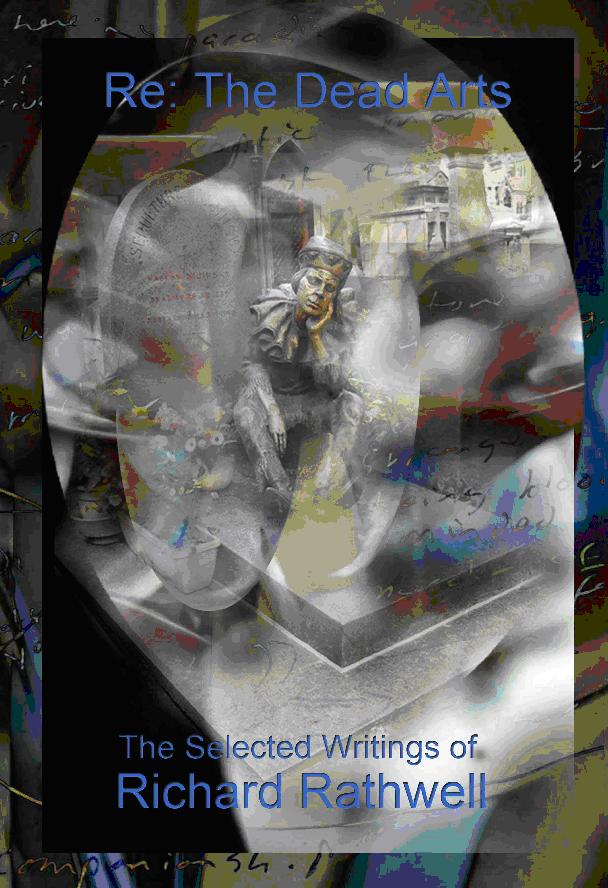
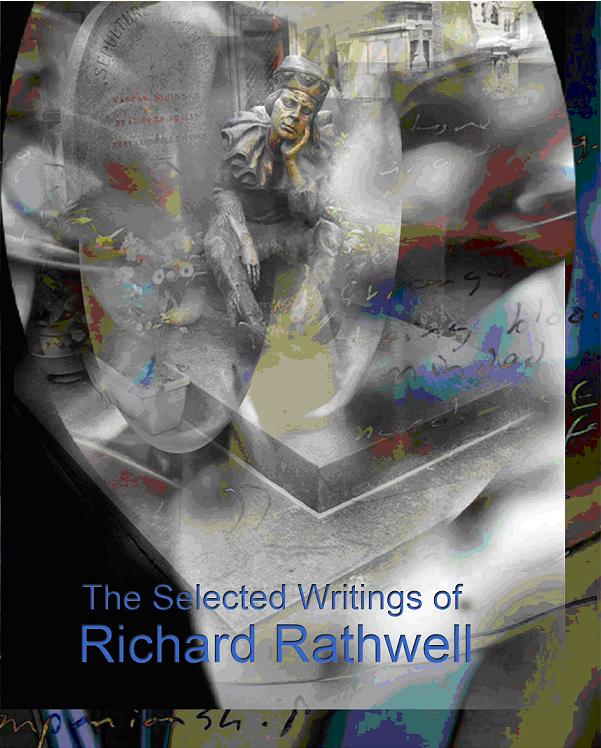
Blue Orange Publishing is delighted to announce the publication of Re: The Dead Arts, the Selected Writings of Richard Rathwell, with book design by Lee Chapman of First Intensity and cover art by Jessica Kolokol. Many of you will have already read extracts on this blog.
It will soon be available in the United States via SPD Books for $18.95/£12.95, as well as in some bookstores in Canada and through this site by sending an email request to thedeadarts@gmail.com. Its ISBN is 0955 1627 0X.
Back Cover:
I only believe that language is a field that has entrances from every world. I desire to find in that field ways my mind can go on journeys out of the place encased.
I want witness. I want report and it is better about a kinf of beauty, an image that is assembled as though for the first time true, even real. And it is in this life, connected.
I want to stay in a group playing in a field.
Don't mind the raw and jagged. The mysterious evil. The burst of blood.
There is the public work to do. The dividing of two into one. The getting out.
Thursday, December 07, 2006
tomfool
I have no strategy or preferences. I am only needy. The main thing is I like readers. Love them, hate them. That's why I do stuff now.
But there are problems. One is that I have no place. I never chose a spot or a context. I just went promiscuously from one landscape to another, one discourse to another. I have origins but no place. Therefore no network, no magnifiers, no social capital, no machine.
The other is that my craziness about authenticity means I have no way, at a very late date and age, of allowing editing anywhere near me. I have thirty years of notes and a recently released imagination, so I am unusually prolific, although not on a yearly average. And I just don't let anything catch up. Not book making, not anything. In this, I write through people, a kind of resonating, despite the plan. I am the worst kind of writer. Not the tiniest bit elitist, not an aspirant genre monopolist, always leaping, leaping, around.
Even though that all is true, due to my story, it does leave that story, a strange story, which is strange to market. I'm not an outlaw academic, an urban contrary, an abused middle class survivor. I'm an old deported guy, years in the bush who, like Alice, has, bemused, come home having missed the entire narrative of the century, accompanied by the white rabbit, talking in tongues and completely detached from mainstreet perspectives.
I need a Tom Fool editor and a network.
I sent a book, The Bush, to a big New York publisher, or at least my son did, and they wrote back saying that it had got to the final committee or something. I may be in a few slush piles. I ain't someone sent down from Oxbridge so slush it is. And I don't fit any small press house styles that I know.
Need a tomfool agent or editor, need discovery. I need someone to make a project of the collected works (now in the garage or on the hard drive).
But there are problems. One is that I have no place. I never chose a spot or a context. I just went promiscuously from one landscape to another, one discourse to another. I have origins but no place. Therefore no network, no magnifiers, no social capital, no machine.
The other is that my craziness about authenticity means I have no way, at a very late date and age, of allowing editing anywhere near me. I have thirty years of notes and a recently released imagination, so I am unusually prolific, although not on a yearly average. And I just don't let anything catch up. Not book making, not anything. In this, I write through people, a kind of resonating, despite the plan. I am the worst kind of writer. Not the tiniest bit elitist, not an aspirant genre monopolist, always leaping, leaping, around.
Even though that all is true, due to my story, it does leave that story, a strange story, which is strange to market. I'm not an outlaw academic, an urban contrary, an abused middle class survivor. I'm an old deported guy, years in the bush who, like Alice, has, bemused, come home having missed the entire narrative of the century, accompanied by the white rabbit, talking in tongues and completely detached from mainstreet perspectives.
I need a Tom Fool editor and a network.
I sent a book, The Bush, to a big New York publisher, or at least my son did, and they wrote back saying that it had got to the final committee or something. I may be in a few slush piles. I ain't someone sent down from Oxbridge so slush it is. And I don't fit any small press house styles that I know.
Need a tomfool agent or editor, need discovery. I need someone to make a project of the collected works (now in the garage or on the hard drive).
Saturday, November 25, 2006
review
The book is by Jon Halliday and Jung Chang.
I think it illustrates that Mao can be read, in addition to having aspergers, as having a simplifying iq bound to the will of a narcissistic personality disorder, that is, the attitude that the only narrative is theirs, that their rightness or their wrongness is always the issue, and that blaming comes in a process which comes before the situation is analysed.
It is also intersting that the guerrilla war things he did were really ways of avoiding risk and commitments that he could be judged on later, and that he could judge others on later, i.e. a leap to the sidelines.
When not doing that he advocated simple chaos and reversals of sense to take ownership of the order to follow.
His adherence to Marxism is like an adherence to Ezra Poundism. You say whatever you think it is that justifies your literal self.
It took an apocalypse for people to believe that, and a coterie of other personalities seeking daddies.
I think it is a great murderous fear of an undergrad student gone monstrous. A mommy's boy with no mommy. It seems that a narrow world, confined to his owm bed, was needed justified by denying the legitamacy of the rest. Competitive with reality.
And let's face it, a bad poet.
God, narratives, when will we be free of them!
I think it illustrates that Mao can be read, in addition to having aspergers, as having a simplifying iq bound to the will of a narcissistic personality disorder, that is, the attitude that the only narrative is theirs, that their rightness or their wrongness is always the issue, and that blaming comes in a process which comes before the situation is analysed.
It is also intersting that the guerrilla war things he did were really ways of avoiding risk and commitments that he could be judged on later, and that he could judge others on later, i.e. a leap to the sidelines.
When not doing that he advocated simple chaos and reversals of sense to take ownership of the order to follow.
His adherence to Marxism is like an adherence to Ezra Poundism. You say whatever you think it is that justifies your literal self.
It took an apocalypse for people to believe that, and a coterie of other personalities seeking daddies.
I think it is a great murderous fear of an undergrad student gone monstrous. A mommy's boy with no mommy. It seems that a narrow world, confined to his owm bed, was needed justified by denying the legitamacy of the rest. Competitive with reality.
And let's face it, a bad poet.
God, narratives, when will we be free of them!
Saturday, November 04, 2006
ladders
There are degrees of some things, sort of ladders or levels of incarnation. This is in my favorite book.
Did you ever get blamed for something the cat did? The usual thing is knocking over a Christmas tree or cracking a TV screen. Isn't it?
Those happened to me with Zorro, my second and third cats.
The first Zorro got jammed in a factory chimney, it was mad for crows, and caused a combined atom bomb, UFO alert in Ottawa South for which I was not blamed.
Zorro the third tried to bring down a gazelle leaping in fear during a program on Serengeti.
Zorro the second was after a blinking light on the tree.
Those are some of my direct experiences of degrees of false accusation.
The first one for me was an accusation of atheism, even of being in league with the devil, in order to spoil Christmas. That was me and that was my motive in that particular world.
It made sense. The tree had fallen on the booze table and the sparks woke gran who thought it was the Germans again and hit dad who then awoke too saying out loud an ancient curse which may have been what burnt the so-called turkey.
The second time, the TV one, resulted in a complicated accusation of communist inspired economic and cultural sabotage calculated by a devious mind towards destruction of the nuclear family.
Mom took one look at that cracked TV and said 'either the TV goes or you go. Which do you think I will decide? I can't afford to fix up both'. She was referring to her continued psychologist bills while reaching for the front door security baseball bat.
'Don't blame the fucking cat you little communist devil" she said.
Another similar, but a higher degree, of false accusation, was experienced by those firemen in Baghdad yesterday.
They were answering an emergency call to control a market fire, including a problem of some still burning people, caused by a suicide bomb.
They were pulled over on their way while riding in their new aid gifted, rehabilitation of the nation, fire truck by American troops , and after being unable to prove they were not fleeing the fire and had not hi-jacked the truck, were shot. Four of them. Shot dead.
The difference in degree so illustrated is Gnostic. I feel some empathy therefore. I lived on earth in Canada. I experienced a metaphor of identity death. They lived in hell and got the real thing.
And who created their hell on earth? Don't blame the cat.
The law of sense and mind applies to Iraq.
The law of sense and mind is that we all really know what the truth is in our souls, the truth of what is really happening and we all know what needs to be done in our hearts.
We know this even if we live in the rainbow light at the base of a shit colored prism looking through it searching for the cat that's gone to blame.
We know, but won't usually see beyond that to know more that there is between us and what we know a prism made by those minions of Ultreye who rule the present world order.
The law of sense has a 'corollary of silly ideas' which is that those who have them will hold on to them forever unless they become accountable for their implementation by forfeiture of their butts.
Tony Blair and Baby Bush cannot be tried for war crimes in their own countries. There are degrees of true accusations, and thoughtful legislation has already been passed in their own homelands to put into place those diabolical degrees of blamelessness.
But they can be if they go to Canada. They can be if they visit Rwanda for that matter. Check that out if you wish at the same time you can check out the story of the fireman above and the other stories elsewhere of rape burning party wager games, snuff movies and so on, that may even now be emerging through the prism of your news.
Here's more. British troops in Afghanistan and Iraq are now signing separate peace agreements with local insurgents, including 'Islamo- Fascists' and, in Hellman province, with the underground representatives of the people, including Taliban.
Canadian troops should be encouraged to do the same in their areas and avoid the development of degrees of participation in war crimes of the sort for which they became world famous in Somalia with their Viet Nam derivative and Disneyland inspired helicopter questioning. They do not want to suffer a degree of false accusations emanating from the top of the ladder to hell.
have made my peace. It will remain at it until I am wronged. I have not made a peace with terrorists but I have no instrument I have faith in to rely on to secure me from them except myself, friends and family. I recommend you and your pets to do both of the same. Then the trials can begin.
I will try to get my tenant's association to make peace and my street, Hyde Vale, too. We will also get a sign, I hope, that terrorists are not welcome on pain of death, nor are the bloody tree nappers at Christmas time (Gnostic New Year). We also should get larger speed bumps.
And a feeding station for cats, a species I have never blamed and certainly if I had ever once even a little have long ago forgiven for I never, ever expected them not to be cats. I knew what they were.
I did expect more of Americans and do of fellow Canadians though. Maybe Canada should make separate peace? Or it too should dissolve, at least culturally to avoid association and blame. And the ladder.
Did you ever get blamed for something the cat did? The usual thing is knocking over a Christmas tree or cracking a TV screen. Isn't it?
Those happened to me with Zorro, my second and third cats.
The first Zorro got jammed in a factory chimney, it was mad for crows, and caused a combined atom bomb, UFO alert in Ottawa South for which I was not blamed.
Zorro the third tried to bring down a gazelle leaping in fear during a program on Serengeti.
Zorro the second was after a blinking light on the tree.
Those are some of my direct experiences of degrees of false accusation.
The first one for me was an accusation of atheism, even of being in league with the devil, in order to spoil Christmas. That was me and that was my motive in that particular world.
It made sense. The tree had fallen on the booze table and the sparks woke gran who thought it was the Germans again and hit dad who then awoke too saying out loud an ancient curse which may have been what burnt the so-called turkey.
The second time, the TV one, resulted in a complicated accusation of communist inspired economic and cultural sabotage calculated by a devious mind towards destruction of the nuclear family.
Mom took one look at that cracked TV and said 'either the TV goes or you go. Which do you think I will decide? I can't afford to fix up both'. She was referring to her continued psychologist bills while reaching for the front door security baseball bat.
'Don't blame the fucking cat you little communist devil" she said.
Another similar, but a higher degree, of false accusation, was experienced by those firemen in Baghdad yesterday.
They were answering an emergency call to control a market fire, including a problem of some still burning people, caused by a suicide bomb.
They were pulled over on their way while riding in their new aid gifted, rehabilitation of the nation, fire truck by American troops , and after being unable to prove they were not fleeing the fire and had not hi-jacked the truck, were shot. Four of them. Shot dead.
The difference in degree so illustrated is Gnostic. I feel some empathy therefore. I lived on earth in Canada. I experienced a metaphor of identity death. They lived in hell and got the real thing.
And who created their hell on earth? Don't blame the cat.
The law of sense and mind applies to Iraq.
The law of sense and mind is that we all really know what the truth is in our souls, the truth of what is really happening and we all know what needs to be done in our hearts.
We know this even if we live in the rainbow light at the base of a shit colored prism looking through it searching for the cat that's gone to blame.
We know, but won't usually see beyond that to know more that there is between us and what we know a prism made by those minions of Ultreye who rule the present world order.
The law of sense has a 'corollary of silly ideas' which is that those who have them will hold on to them forever unless they become accountable for their implementation by forfeiture of their butts.
Tony Blair and Baby Bush cannot be tried for war crimes in their own countries. There are degrees of true accusations, and thoughtful legislation has already been passed in their own homelands to put into place those diabolical degrees of blamelessness.
But they can be if they go to Canada. They can be if they visit Rwanda for that matter. Check that out if you wish at the same time you can check out the story of the fireman above and the other stories elsewhere of rape burning party wager games, snuff movies and so on, that may even now be emerging through the prism of your news.
Here's more. British troops in Afghanistan and Iraq are now signing separate peace agreements with local insurgents, including 'Islamo- Fascists' and, in Hellman province, with the underground representatives of the people, including Taliban.
Canadian troops should be encouraged to do the same in their areas and avoid the development of degrees of participation in war crimes of the sort for which they became world famous in Somalia with their Viet Nam derivative and Disneyland inspired helicopter questioning. They do not want to suffer a degree of false accusations emanating from the top of the ladder to hell.
have made my peace. It will remain at it until I am wronged. I have not made a peace with terrorists but I have no instrument I have faith in to rely on to secure me from them except myself, friends and family. I recommend you and your pets to do both of the same. Then the trials can begin.
I will try to get my tenant's association to make peace and my street, Hyde Vale, too. We will also get a sign, I hope, that terrorists are not welcome on pain of death, nor are the bloody tree nappers at Christmas time (Gnostic New Year). We also should get larger speed bumps.
And a feeding station for cats, a species I have never blamed and certainly if I had ever once even a little have long ago forgiven for I never, ever expected them not to be cats. I knew what they were.
I did expect more of Americans and do of fellow Canadians though. Maybe Canada should make separate peace? Or it too should dissolve, at least culturally to avoid association and blame. And the ladder.
Tuesday, October 17, 2006
costume parties
Costume Parties
In the cosmology I adhere to Halloween is the beginning of three significant days. On Halloween the souls of all the dead who were sinners, and not saints that’s the next day,, are released by a guy who I’ll explain below, to scurry all over the earth to search for their graves. If they call on you, you must feed them.
The next significant day is Christmas. That is when the souls and separate memories of dead family return home invisibly, or partially visibly, in various sizes, and moods. They don’t come back the way you remember them. They come back home literally. That is partially what was going on in Bethlehem.
In my area, a quite parochial one, you laid stones from where the dead were buried to your door. They are supposed to rest on the stones as they come slowly painfully to your house. But some say it is because there memories of the way are so different.
The dead participate in the holiday feasts, the ones held to give a positive characterisation to what is really going on, and even tell jokes or alternatively break up relationships , cause fights and settle scores by introducing deadly gossip.. You must feed them.
Those who rise and see no stones can go anywhere. Those who were murdered and buried, perhaps secretly, may lay their own stones to their killer’s door. Rejected lovers can do a similar thing with splintered bone.
If you can’t lay stones, say your dead are in another country you put out a candle and hope for the best.
The final day is Valentines Day. That is when the souls go back to their other place. Between Christmas and Valentines Day they all have been doing as they wish. Some observe wars; some go back to school, some hold hands with others and whip up winds. Some cause diseases.
Anyway that is the cosmology.
A lot of the very important memory objects I have are associated with Halloween. It is when things happen. I have been in an intense struggle with my memory lately. One reason is that I have reached a point where I am remembering more than I am forgetting. This is very uncomfortable. It is uncomfortable because the other thing is that like most people I believe my memory more than any so-called truth presented by academic quacks or loo narratives. Like most people I regard myself entirely spiritually, no matter how I see others and how hard I pretend not to. Everyone secretly believes they live an entirely spiritual life and they justify their actions in that context. Their memory is a record of that in images. In that respect it is a form of poetry. It can be a kind of writing too where the inner integrity is to record the actuality of the images and their relationships, and not mess that up with an imposed external narrative structure or sets of associations.
So at this time of year I regularly revise my obituary in anticipation of Halloween. It is a kind of retrospective New Year’s resolution. I recommend this exercise to everyone. The one I chose last year was Beshkati in style. It said: 'He struggled all his live with immortality and lost gloriously. He struggled with infallibility and lost consistently. Let him be forgotten and rest in peace.” I’ll say that when they come knocking with their infernal jokes wearing their funny guises.
2.
In this context it is appropriate to enter once again into the eternal question ‘who is dat guy anywho?
I will start with the Tar Baby. For those of you who don’t know the Tar Baby it don’t matter. The only necessary context is that I am talking about a fundamental B’rer Rabbit apocrypha.
B’rer rabbit is an avatar of dat guy. He represents the other, and in some instances precisely the other, to dominant narratives. But it is deeper than that.
B’rer rabbit pleads with his enemies every time they catch him not to throw him into the briar patch. He describes the briar patch as a place of great horror. A place of darkness and doom. He is so oppositional to them they always do throw him there.
That is where he lives.
B’rer rabbit made the Tar Baby. The Tar Baby is just that kind of fat black squirming baby that you want to touch. But B’rer Rabbit pleads with you not to. So you do and you get stuck there with your senses tarred over sucked in with the struggling lumps of the other fools.
B’rer Rabbit can be Friar Tuck, the apocrypha Friar Tuck who waits by the stream like a Templar to offer to carry poor sinners across. Then on the other side he hits you with a stick and makes you carry him back as the stream widens and widens.
Or that scorpion. You know the scorpion who swears to the crocodile that he will not hurt him but rather help him if only the crocodile carries him over that same stream. At the other side, to the protest of the dying, stung, crocodile the scorpion says ‘what did you expect I meant anyway, I am only a scorpion.’
But he is Loki, the joking, pesky, nearly fallible, almost evil human, truth telling uberdivinity called ‘the liar’ by all the Goddesses and Gods. Dat is the one who was so precise in imagery and characterisation of everyone in Valhalla that Odin sewed up his moth with catgut. But the words still came.
And there is the one called Satan in that complete fantasy of Christianity deranged Victorian banalogues. I mean though the real guy who met the real Jesus at the edge of the wilderness just after Jesus had been there meditating, perhaps on his obituary, maybe on taking up a career as a performance poet, for forty days.
I know exactly the spot. Others do as well as there were witnesses at the time and the whole thing was recorded. The spot is on the top of a cut in the canyon wall of the desert plateau overlooking Assuit. Near there are caves in which various mystics, including the poor guy proscribed by Emperor Theodosius, and whose followers were massacred like the Cathars were later, caves where those mystics through the centuries thought about the encounter, remembered it, recalled it and some wrote about it, or even re-enacted it in the realm of imagination and memory. There are some there now.
Jesus had gone back to Assuit inspired by some nostalgia when, seeming to all as a basically unemployed carpenter and mason; he had reached a career crisis. Assuit was where he and his mom and dad lived after fleeing from Bethlehem, having not been registered in Herod’s fatal death cult tax net. In Assuit, Jesus had learned his P’s and Q’s from Philo, the Jewish neo-Platonist travelling tutor and carpentry and masonry from his dad. Jesus went there to hang out for awhile in the old hometown and visit the desert as you do when you are in Assuit. He wanted to chill.
But dat guy, Satan, Loki, B’rer Rabbit, whoever , met him at the desert edge and pointing down to Assuit in the Nile Valley, its only three miles wide there, and said first how is it going guy? Got your gig figured out? Know what 'cher gonna do?
Then he said ‘how would you like all the kingdoms of the world, you can have them, the whole lot if you just forget your origins a little. Let go fellow, live a little.’
The last bit was just a diversion. What few realise, but the witnesses do, are that, let us call him Satan, and did not himself (or herself) want the bloody kingdoms of the world. And isn’t interesting that he was in charge of them then? All the kingdoms of the world run by that guy. He was the boss.
But Dat guy didn’t want the job. He wanted Jesus’ life. He wanted it then and the gig to be. He wanted the rep. He wanted to wander around in the desert and meditate. He wanted to ride on asses backs, he wanted to have a virgin mom, he wanted to curse God on the cross and rise from the dead, and he wanted to be a rung in the great trialectics of life. He wanted to be the magi. He wanted in fact to trick ol’ Jesus into taking a load off his back. He wanted to trick him into touching the Tar Baby. Into seeing what that kind of shit was really like. He wanted him to be the real son of God to take off the mask and put on the costume.
So what really happened next? Do you think back home in the briar patch on the other side of the stream he will start to talk straight?
In the cosmology I adhere to Halloween is the beginning of three significant days. On Halloween the souls of all the dead who were sinners, and not saints that’s the next day,, are released by a guy who I’ll explain below, to scurry all over the earth to search for their graves. If they call on you, you must feed them.
The next significant day is Christmas. That is when the souls and separate memories of dead family return home invisibly, or partially visibly, in various sizes, and moods. They don’t come back the way you remember them. They come back home literally. That is partially what was going on in Bethlehem.
In my area, a quite parochial one, you laid stones from where the dead were buried to your door. They are supposed to rest on the stones as they come slowly painfully to your house. But some say it is because there memories of the way are so different.
The dead participate in the holiday feasts, the ones held to give a positive characterisation to what is really going on, and even tell jokes or alternatively break up relationships , cause fights and settle scores by introducing deadly gossip.. You must feed them.
Those who rise and see no stones can go anywhere. Those who were murdered and buried, perhaps secretly, may lay their own stones to their killer’s door. Rejected lovers can do a similar thing with splintered bone.
If you can’t lay stones, say your dead are in another country you put out a candle and hope for the best.
The final day is Valentines Day. That is when the souls go back to their other place. Between Christmas and Valentines Day they all have been doing as they wish. Some observe wars; some go back to school, some hold hands with others and whip up winds. Some cause diseases.
Anyway that is the cosmology.
A lot of the very important memory objects I have are associated with Halloween. It is when things happen. I have been in an intense struggle with my memory lately. One reason is that I have reached a point where I am remembering more than I am forgetting. This is very uncomfortable. It is uncomfortable because the other thing is that like most people I believe my memory more than any so-called truth presented by academic quacks or loo narratives. Like most people I regard myself entirely spiritually, no matter how I see others and how hard I pretend not to. Everyone secretly believes they live an entirely spiritual life and they justify their actions in that context. Their memory is a record of that in images. In that respect it is a form of poetry. It can be a kind of writing too where the inner integrity is to record the actuality of the images and their relationships, and not mess that up with an imposed external narrative structure or sets of associations.
So at this time of year I regularly revise my obituary in anticipation of Halloween. It is a kind of retrospective New Year’s resolution. I recommend this exercise to everyone. The one I chose last year was Beshkati in style. It said: 'He struggled all his live with immortality and lost gloriously. He struggled with infallibility and lost consistently. Let him be forgotten and rest in peace.” I’ll say that when they come knocking with their infernal jokes wearing their funny guises.
2.
In this context it is appropriate to enter once again into the eternal question ‘who is dat guy anywho?
I will start with the Tar Baby. For those of you who don’t know the Tar Baby it don’t matter. The only necessary context is that I am talking about a fundamental B’rer Rabbit apocrypha.
B’rer rabbit is an avatar of dat guy. He represents the other, and in some instances precisely the other, to dominant narratives. But it is deeper than that.
B’rer rabbit pleads with his enemies every time they catch him not to throw him into the briar patch. He describes the briar patch as a place of great horror. A place of darkness and doom. He is so oppositional to them they always do throw him there.
That is where he lives.
B’rer rabbit made the Tar Baby. The Tar Baby is just that kind of fat black squirming baby that you want to touch. But B’rer Rabbit pleads with you not to. So you do and you get stuck there with your senses tarred over sucked in with the struggling lumps of the other fools.
B’rer Rabbit can be Friar Tuck, the apocrypha Friar Tuck who waits by the stream like a Templar to offer to carry poor sinners across. Then on the other side he hits you with a stick and makes you carry him back as the stream widens and widens.
Or that scorpion. You know the scorpion who swears to the crocodile that he will not hurt him but rather help him if only the crocodile carries him over that same stream. At the other side, to the protest of the dying, stung, crocodile the scorpion says ‘what did you expect I meant anyway, I am only a scorpion.’
But he is Loki, the joking, pesky, nearly fallible, almost evil human, truth telling uberdivinity called ‘the liar’ by all the Goddesses and Gods. Dat is the one who was so precise in imagery and characterisation of everyone in Valhalla that Odin sewed up his moth with catgut. But the words still came.
And there is the one called Satan in that complete fantasy of Christianity deranged Victorian banalogues. I mean though the real guy who met the real Jesus at the edge of the wilderness just after Jesus had been there meditating, perhaps on his obituary, maybe on taking up a career as a performance poet, for forty days.
I know exactly the spot. Others do as well as there were witnesses at the time and the whole thing was recorded. The spot is on the top of a cut in the canyon wall of the desert plateau overlooking Assuit. Near there are caves in which various mystics, including the poor guy proscribed by Emperor Theodosius, and whose followers were massacred like the Cathars were later, caves where those mystics through the centuries thought about the encounter, remembered it, recalled it and some wrote about it, or even re-enacted it in the realm of imagination and memory. There are some there now.
Jesus had gone back to Assuit inspired by some nostalgia when, seeming to all as a basically unemployed carpenter and mason; he had reached a career crisis. Assuit was where he and his mom and dad lived after fleeing from Bethlehem, having not been registered in Herod’s fatal death cult tax net. In Assuit, Jesus had learned his P’s and Q’s from Philo, the Jewish neo-Platonist travelling tutor and carpentry and masonry from his dad. Jesus went there to hang out for awhile in the old hometown and visit the desert as you do when you are in Assuit. He wanted to chill.
But dat guy, Satan, Loki, B’rer Rabbit, whoever , met him at the desert edge and pointing down to Assuit in the Nile Valley, its only three miles wide there, and said first how is it going guy? Got your gig figured out? Know what 'cher gonna do?
Then he said ‘how would you like all the kingdoms of the world, you can have them, the whole lot if you just forget your origins a little. Let go fellow, live a little.’
The last bit was just a diversion. What few realise, but the witnesses do, are that, let us call him Satan, and did not himself (or herself) want the bloody kingdoms of the world. And isn’t interesting that he was in charge of them then? All the kingdoms of the world run by that guy. He was the boss.
But Dat guy didn’t want the job. He wanted Jesus’ life. He wanted it then and the gig to be. He wanted the rep. He wanted to wander around in the desert and meditate. He wanted to ride on asses backs, he wanted to have a virgin mom, he wanted to curse God on the cross and rise from the dead, and he wanted to be a rung in the great trialectics of life. He wanted to be the magi. He wanted in fact to trick ol’ Jesus into taking a load off his back. He wanted to trick him into touching the Tar Baby. Into seeing what that kind of shit was really like. He wanted him to be the real son of God to take off the mask and put on the costume.
So what really happened next? Do you think back home in the briar patch on the other side of the stream he will start to talk straight?
Monday, October 02, 2006
texts about aspergers (verse one)
Texts About Aspergers
1.
A Serious Poem About Aspergers.
(Not, for example, for Ass purgers)
As a buzzy
you haven't seen
fragmented windows
reflect reverse thoughts
of a Frisbee changing direction
at a glance to
mirror the sense of harbour seals
and the perverse madness of ants
cold water empathy reflecting
cold fantasy and sunbeam
jokes at essences of terror
floating over the park in broken verses
revealing drops in the water
mimicking pains shattering against
orders of poetry and lost in
the behaviour of black light
of air born sea animals
and gusting laughter
silent under circling
beauties of mind
embracing absolutely particular
chaos.
1.
A Serious Poem About Aspergers.
(Not, for example, for Ass purgers)
As a buzzy
you haven't seen
fragmented windows
reflect reverse thoughts
of a Frisbee changing direction
at a glance to
mirror the sense of harbour seals
and the perverse madness of ants
cold water empathy reflecting
cold fantasy and sunbeam
jokes at essences of terror
floating over the park in broken verses
revealing drops in the water
mimicking pains shattering against
orders of poetry and lost in
the behaviour of black light
of air born sea animals
and gusting laughter
silent under circling
beauties of mind
embracing absolutely particular
chaos.
Friday, September 22, 2006
the wedding
The Wedding
to Umana bint Kualib
West Indies Packet to Montreal
With news about two weeks before Christmas
But six weeks travelling
About effects
Of the promulgation of the doctrine
Seven years before that in Rome
Precisely
In Chile, December eight,
Eighteen sixty five
At the Church of La Compana where
Three thousand two hundred seven
Ladies of the higher classes
Declared virgins, are praying
For Immaculate Conception
Young ladies
and a few men with
the poorer with children
in back
Those richer
Declared in front
without
but one to be revealed
The month for the Virgin
Is ending, a miracle is coming
Everyone knows.
In a Church festooned
With twenty thousand lights
Large candles crescenting
At the foot of Mary
Communicating fire to her draperies
Spreading to all parts
To rain from the roof
In great drops
Escape blocked with outside rescuers
And the men
climbing over the poor
The ladies falling in all directions
Arms torn from bodies into heaps
Roof and steeple cascading
After fifteen minutes only
wall shards remain
climbing upwards
over two thousand black bodies
Upwards of twenty cartloads were removed
by Christmas
And this news arriving
to a declared fiancé in Montreal
far after that Christmas
when he was secretly
made a priest.
to Umana bint Kualib
West Indies Packet to Montreal
With news about two weeks before Christmas
But six weeks travelling
About effects
Of the promulgation of the doctrine
Seven years before that in Rome
Precisely
In Chile, December eight,
Eighteen sixty five
At the Church of La Compana where
Three thousand two hundred seven
Ladies of the higher classes
Declared virgins, are praying
For Immaculate Conception
Young ladies
and a few men with
the poorer with children
in back
Those richer
Declared in front
without
but one to be revealed
The month for the Virgin
Is ending, a miracle is coming
Everyone knows.
In a Church festooned
With twenty thousand lights
Large candles crescenting
At the foot of Mary
Communicating fire to her draperies
Spreading to all parts
To rain from the roof
In great drops
Escape blocked with outside rescuers
And the men
climbing over the poor
The ladies falling in all directions
Arms torn from bodies into heaps
Roof and steeple cascading
After fifteen minutes only
wall shards remain
climbing upwards
over two thousand black bodies
Upwards of twenty cartloads were removed
by Christmas
And this news arriving
to a declared fiancé in Montreal
far after that Christmas
when he was secretly
made a priest.
Sunday, September 17, 2006
the image that fills
Sneaking Rimbaud back again too you guys?
How he loved sea journeys,
high banked empty overland in
bubbled green mountain on animal back.
Java, Harar.
Arrive and run, turn
live in fever
write nothing in
some other arms
Think about distance
the image that fills space
between
How he loved sea journeys,
high banked empty overland in
bubbled green mountain on animal back.
Java, Harar.
Arrive and run, turn
live in fever
write nothing in
some other arms
Think about distance
the image that fills space
between
Saturday, August 26, 2006
the development of style
...the development of style and the measure of originality paradoxically came from the transcendence of self by killing the ego in all its forms--symbolic, real, complementary and oppositional. It came from both the destruction of the false narrative of self, which was inevitably cliche, and by the confrontation of the dead other, the frozen memory of the word deflated and dropping into oblivion. By the architecture of that. By the projections of self sitting and mocking, like birds on a wire. To transcend and destroy self and to flee from the dead memory of the world, one had to see the fear and kill it. This was difficult when your tools were only imagination and action based on that. What happened first you knew is that confronting fear brought memory to life and originality. It connected with the deadly other. The ego quivered. It desired passionately the shelter of cliche and stereotype diving into them like an ostrich into the ground. In its fear and morbid desire it could no longer laugh, love or anything as the energy for this came from outside, from the senses, from the coordination with the mind from the other's electrifying of the imagination. But it desired that love.
-This is an excerpt from the short story 'RE: CANADA BANANA', which appears in the upcoming book: RE: THE DEAD ARTS -- THE SELECTED WRITINGS OF RICHARD RATHWELL.
-This is an excerpt from the short story 'RE: CANADA BANANA', which appears in the upcoming book: RE: THE DEAD ARTS -- THE SELECTED WRITINGS OF RICHARD RATHWELL.
Sunday, August 13, 2006
summary of the political program of the party of gnosis (bektashi)
1 To begin at the final point, anyone who says that they represent a group with any identity at all is a fraud.
2. To go on, anyone who says they have correct ideas is a charlatan.
3. It is proposed that the world requires continuous regime change from the smallest association up to the gates of heaven without exception.
4. Any growing institution should be dissolved into component parts or even smaller and nicer ones. This includes superpowers into deserts, forests and mountains.
5. A general compulsory disarmament is proposed beginning with the elimination of the reasons for arms. Mental disarmament should generally precede political disarmament.
6. There is nothing wrong with boundaries of any sort.
7. Social privilege should be based on social investment including that of the generations.
8. Basic individual needs being met and exceeded should be the only responsibility of the collective endeavour.
9. Continuous incivilities are punishable by death
10. Violations of sustainability are punishable by death.
11. Privacy should be left alone.
12 Any wealth not destined for public culture or social investment is theft.
13. There is no excuse to harm a child
13. Everything else is also to be ultimately unregulated.
2. To go on, anyone who says they have correct ideas is a charlatan.
3. It is proposed that the world requires continuous regime change from the smallest association up to the gates of heaven without exception.
4. Any growing institution should be dissolved into component parts or even smaller and nicer ones. This includes superpowers into deserts, forests and mountains.
5. A general compulsory disarmament is proposed beginning with the elimination of the reasons for arms. Mental disarmament should generally precede political disarmament.
6. There is nothing wrong with boundaries of any sort.
7. Social privilege should be based on social investment including that of the generations.
8. Basic individual needs being met and exceeded should be the only responsibility of the collective endeavour.
9. Continuous incivilities are punishable by death
10. Violations of sustainability are punishable by death.
11. Privacy should be left alone.
12 Any wealth not destined for public culture or social investment is theft.
13. There is no excuse to harm a child
13. Everything else is also to be ultimately unregulated.
Sunday, August 06, 2006
summary of bektashi definitions
Summary of Bashkati Definitions
History: Is what didn’t happen
Identity : (of a person or group) is what they definitely are not, never were and are not becoming
Memory: Is the other way of saying what is happening now
Apocalypse: is the usual thing
Narrative: erases truth
Image: disguises beauty
Poetry: precedes science
Love: is the enemy of empathy
Destiny: is a dead end.
History: Is what didn’t happen
Identity : (of a person or group) is what they definitely are not, never were and are not becoming
Memory: Is the other way of saying what is happening now
Apocalypse: is the usual thing
Narrative: erases truth
Image: disguises beauty
Poetry: precedes science
Love: is the enemy of empathy
Destiny: is a dead end.
Friday, August 04, 2006
interview
Excerpts from Birthday Interview with Richard Rathwell
BOP: On what did you base your book 'Red the Nile, Blue the Hills'?
RR: The original idea is taken from some translations I did myself from Rimbaud’s Ethiopian poems. There was also his journal of his trip to Java which a copy of is in my family. Like all of my novels it is a road trip mainly of images. In a previous novel I took the images from false primitivist painting. In this one it is from images done by artists whose religion restricts them from representation. It is also a true story.
BOP: Many have said the poems in your Book ‘Poems from the Beak’ are bossy and didactic. Some say they are ‘know it all’. Did you do that on purpose?
RR: I would prefer that to being called Aspergers prematurely. In fact the poems are adapted from poems written in the youth of one of the characters in my novel ‘Borderline: Casebook Translations'. The book depicts several identities psychologically as they are seen by each other. It is a prequel to a Fleuve Roman. The Beak is a central character. She and the others all have casebooks published elsewhere. I contacted and visited all the characters recently, fifty years after the events to see what they were doing now. The Beak was the only one I couldn’t find. I don’t know where she is. Some of her poems won awards but she is largely forgotten. Yes she did know it all.
BOP: Another thing that is said, frankly, is that you write as though you hate readers.
RR: I have loved all the readers I have initially written for. Really. I have made many of them characters. I try to do authentic witness. To do this I write in such a way as to avoid as much usual structure and reference as I can, I don’t mean stereotypes and clichés but everything that comes with you. I write slowly when it was hot. I just want to stay on the trip and see what appears there without leaving it for some dreaming. It is hard to do honestly and keep at it no matter how simple and uncharged it is or askew with syntax. It isn’t fun. Like when I realised I had seen a twenty foot high dog in the desert and then forgotten it because I was in the midst of an argument on Literature, or what I actually did when friends were murdered. Now I am writing by going through communities and reflecting them. So the discourse is developmental. It isn’t entertainment. It isn’t just processing by form. It is to get something. It requires participation a bit .
BOP: Is your writing political? Some of it seems to be a defence of gangster states. This has been read in the collection ‘Death’s Doors.’, and in some of the poetry in “One Poem Forward, Two Poems Back"
RR: No. What has been read as political is really an ironical celebration of death and banality meant to bugger it up for something nicer. The other necessary thing is that it does entirely compose an epic, a kind of Fleuve Roman in which the distances between the soul, spirit and body are getting greater. The boundaries are getting more detached. That means the connections are more intense. So it sounds as though the world is at stake. It isn’t. You’ll see this in ‘Re: The Dead Arts 'coming out soon.
BOP: Did you mean just now to disrespect Aspergers persons? That is reprehensible!
RR: My record on the question of Aspergers Syndrome is clear. I have written positively on what it would be like if Aspergers ruled the world. I have also written a factumentary called “Tim and Dorothy” which highlights an actual incidence where this was planned. The proceeds from that go to the Asperger’s Liberation Front.
BOP: so what is next for you, Richard?
RR. I will continue my publishing venture but expand the list beyond the present authors to include the best of dissonant writing. I want it to be an oasis against narrative, especially international narrative which is part of an attempt to get just one. One new initiative is an e-magazine; becoming eventually hard copy called ‘Trek Report’ this is to give voice for new writing of epics, in mind and on ground. The epic has gone missing mainly because of parochial and memoirist writing and the web. The existing ‘Partisan Diary’ will still be a place for the substantial olden times anti-avant garde stuff like “Cows of Freedom “ and “Thought Materials”. I will continue to campaign as I did recently by putting the Sunday Times before the press complaints committee for hate crimes against the development of genocidal absurdities like the United Nations becoming the Mid-Wife of war, the United Kingdom becoming a failed state, the restriction of rights to regime change only to Moslem countries, the development of theories of exchange in the killing of children or of moral equivalencies in chemical warfare, the fact that aid programs are designed to increase famine, the complete destruction of a sustainable planet and so on. There is a public duty after all if only to animals and very short people.
BOP: On what did you base your book 'Red the Nile, Blue the Hills'?
RR: The original idea is taken from some translations I did myself from Rimbaud’s Ethiopian poems. There was also his journal of his trip to Java which a copy of is in my family. Like all of my novels it is a road trip mainly of images. In a previous novel I took the images from false primitivist painting. In this one it is from images done by artists whose religion restricts them from representation. It is also a true story.
BOP: Many have said the poems in your Book ‘Poems from the Beak’ are bossy and didactic. Some say they are ‘know it all’. Did you do that on purpose?
RR: I would prefer that to being called Aspergers prematurely. In fact the poems are adapted from poems written in the youth of one of the characters in my novel ‘Borderline: Casebook Translations'. The book depicts several identities psychologically as they are seen by each other. It is a prequel to a Fleuve Roman. The Beak is a central character. She and the others all have casebooks published elsewhere. I contacted and visited all the characters recently, fifty years after the events to see what they were doing now. The Beak was the only one I couldn’t find. I don’t know where she is. Some of her poems won awards but she is largely forgotten. Yes she did know it all.
BOP: Another thing that is said, frankly, is that you write as though you hate readers.
RR: I have loved all the readers I have initially written for. Really. I have made many of them characters. I try to do authentic witness. To do this I write in such a way as to avoid as much usual structure and reference as I can, I don’t mean stereotypes and clichés but everything that comes with you. I write slowly when it was hot. I just want to stay on the trip and see what appears there without leaving it for some dreaming. It is hard to do honestly and keep at it no matter how simple and uncharged it is or askew with syntax. It isn’t fun. Like when I realised I had seen a twenty foot high dog in the desert and then forgotten it because I was in the midst of an argument on Literature, or what I actually did when friends were murdered. Now I am writing by going through communities and reflecting them. So the discourse is developmental. It isn’t entertainment. It isn’t just processing by form. It is to get something. It requires participation a bit .
BOP: Is your writing political? Some of it seems to be a defence of gangster states. This has been read in the collection ‘Death’s Doors.’, and in some of the poetry in “One Poem Forward, Two Poems Back"
RR: No. What has been read as political is really an ironical celebration of death and banality meant to bugger it up for something nicer. The other necessary thing is that it does entirely compose an epic, a kind of Fleuve Roman in which the distances between the soul, spirit and body are getting greater. The boundaries are getting more detached. That means the connections are more intense. So it sounds as though the world is at stake. It isn’t. You’ll see this in ‘Re: The Dead Arts 'coming out soon.
BOP: Did you mean just now to disrespect Aspergers persons? That is reprehensible!
RR: My record on the question of Aspergers Syndrome is clear. I have written positively on what it would be like if Aspergers ruled the world. I have also written a factumentary called “Tim and Dorothy” which highlights an actual incidence where this was planned. The proceeds from that go to the Asperger’s Liberation Front.
BOP: so what is next for you, Richard?
RR. I will continue my publishing venture but expand the list beyond the present authors to include the best of dissonant writing. I want it to be an oasis against narrative, especially international narrative which is part of an attempt to get just one. One new initiative is an e-magazine; becoming eventually hard copy called ‘Trek Report’ this is to give voice for new writing of epics, in mind and on ground. The epic has gone missing mainly because of parochial and memoirist writing and the web. The existing ‘Partisan Diary’ will still be a place for the substantial olden times anti-avant garde stuff like “Cows of Freedom “ and “Thought Materials”. I will continue to campaign as I did recently by putting the Sunday Times before the press complaints committee for hate crimes against the development of genocidal absurdities like the United Nations becoming the Mid-Wife of war, the United Kingdom becoming a failed state, the restriction of rights to regime change only to Moslem countries, the development of theories of exchange in the killing of children or of moral equivalencies in chemical warfare, the fact that aid programs are designed to increase famine, the complete destruction of a sustainable planet and so on. There is a public duty after all if only to animals and very short people.
Subscribe to:
Posts (Atom)